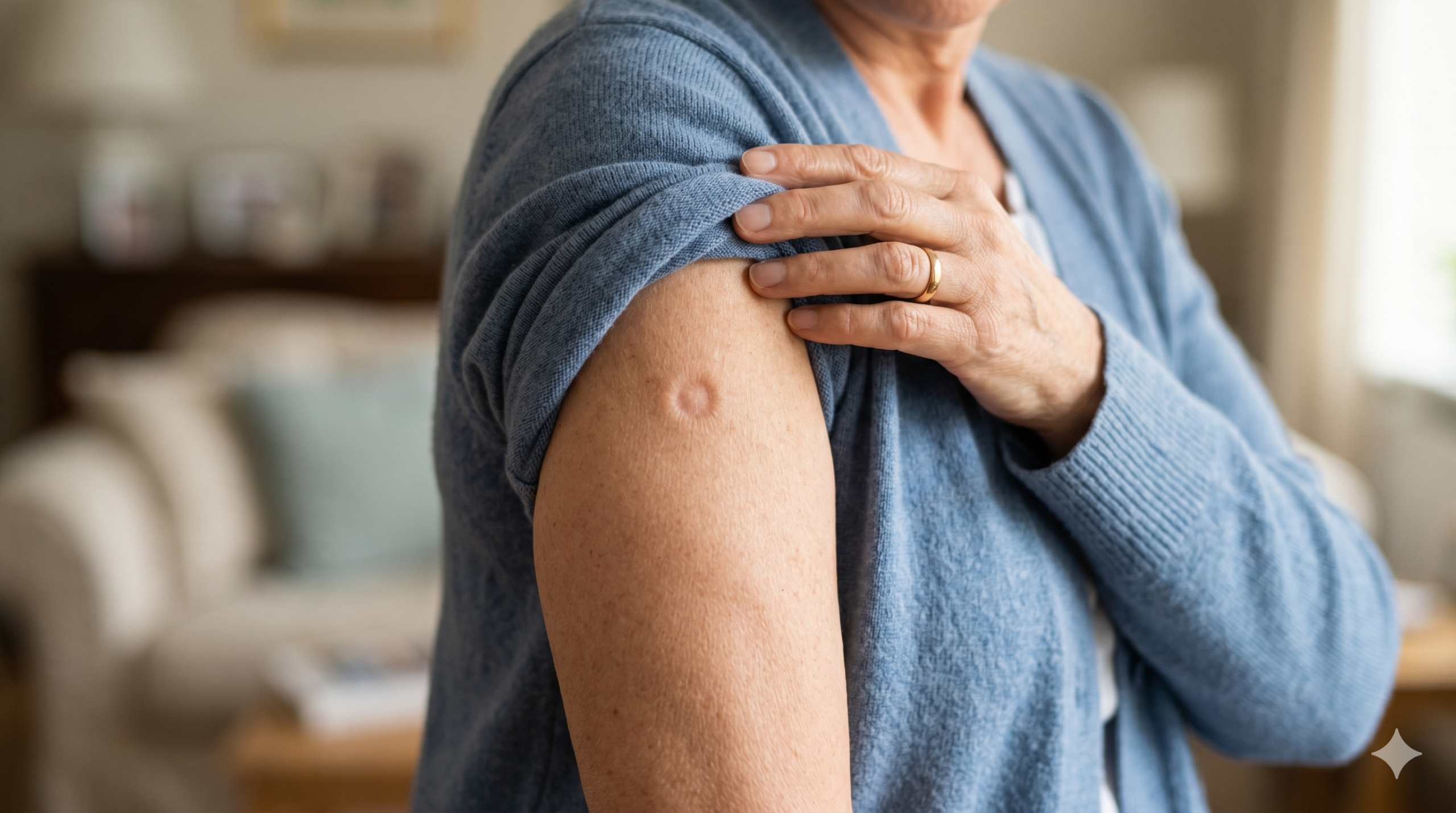
A Familiar Mark We All Stopped Noticing
Growing up, I never really paid attention to it. My mother had a faint, circular scar on her upper arm. It sat there like any other old blemish, just a familiar part of the background of my childhood. You know how it is with things you see every day—you eventually stop looking at them.
Years later, during a totally ordinary afternoon, I saw that exact same scar again. I was helping an older woman step off a train when her sleeve slipped up. There it was: the same place, the same distinct, round shape.
Instantly, I thought of my mom.
I didn’t say anything to the stranger on the train, but I called my mother that same afternoon to ask the question I’d carried quietly for years. Her answer was incredibly simple.
“It’s from the smallpox vaccine.”
A Tiny Badge Shared by a Generation
If you were born in the United States before the early 1970s—or in similar timeframes around the world—there’s a very good chance you have this exact same mark on your upper arm.
For some, it’s faded to a barely visible patch of skin. For others, it’s just as clear today as it was decades ago. Millions of people carry it without a second thought. But that little indentation represents something much bigger than a quick trip to the doctor.
Why We Needed the Vaccine in the First Place
It’s hard for younger generations to grasp just how much communities feared smallpox. It was one of the most dangerous infectious diseases on the planet.
It usually started with fever, body aches, and deep exhaustion. Then came a rash, followed by painful skin lesions. Families lived with a daily uncertainty that feels completely foreign to us now. Before the vaccine became widely available, smallpox wasn’t just a chapter in a history book—it was a very real, very immediate human threat.
Why Did It Leave Such a Specific Mark?
If you’ve ever wondered why this specific shot left a scar when modern vaccines usually don’t, the answer lies in the needle.
Doctors didn’t use a standard syringe. Instead, they used a special, two-pronged tool called a bifurcated needle. They dipped it in the vaccine and lightly punctured the skin multiple times in a small circle. This unique process triggered a very specific reaction:
- First, a small bump appeared.
- That bump turned into a blister.
- The blister dried up and formed a scab.
- Once it healed, it left behind that recognizable round scar.
Because healthcare workers usually gave the shot on the upper arm, an entire generation ended up with matching marks.
A Quiet, Global Victory
Today, the eradication of smallpox is considered one of the absolute greatest victories in public health history.
Through massive, worldwide vaccination efforts across several generations, the disease was slowly pushed back until transmission stopped. In 1980, the World Health Organization officially declared smallpox eradicated from the globe.
Think about that for a second. A virus that caused fear across entire continents is simply… gone. It was the first human disease ever eliminated through global teamwork.
More Than Just a Blemish
Now, when I look at that little circular mark, it feels completely different to me.
It isn’t just a scar. It’s a quiet reminder of resilience, modern medicine, and what we can actually achieve when we work together to protect each other.
History doesn’t just live in dusty museum exhibits. Sometimes, it stays right here with us—written on our skin, hiding in plain sight until we finally see it with new eyes.
Do you or someone in your family have this small circular scar? It turns out, you’re carrying a pretty incredible story.
Important Note:
This article is written for entertainment and general informational purposes only. The stories, ideas, and information shared here are meant to be interesting, thought-provoking, or enjoyable to read.
Nothing in this article should be considered professional advice of any kind — whether medical, legal, financial, psychological, or otherwise. The content on this blog is not a substitute for consulting with qualified professionals.
Always do your own research and speak with a trusted expert before making any important decisions in your life. The author and publisher of this blog are not responsible or liable for any actions you take (or do not take) based on the information in this article.
Information and stories may be based on personal experiences, public sources, or creative interpretation. While we aim to share content that is accurate and respectful, we cannot guarantee that everything will be completely up to date or suitable for every reader’s situation.
By continuing to read this blog, you understand and agree that this content is for entertainment only.
Leave a Reply