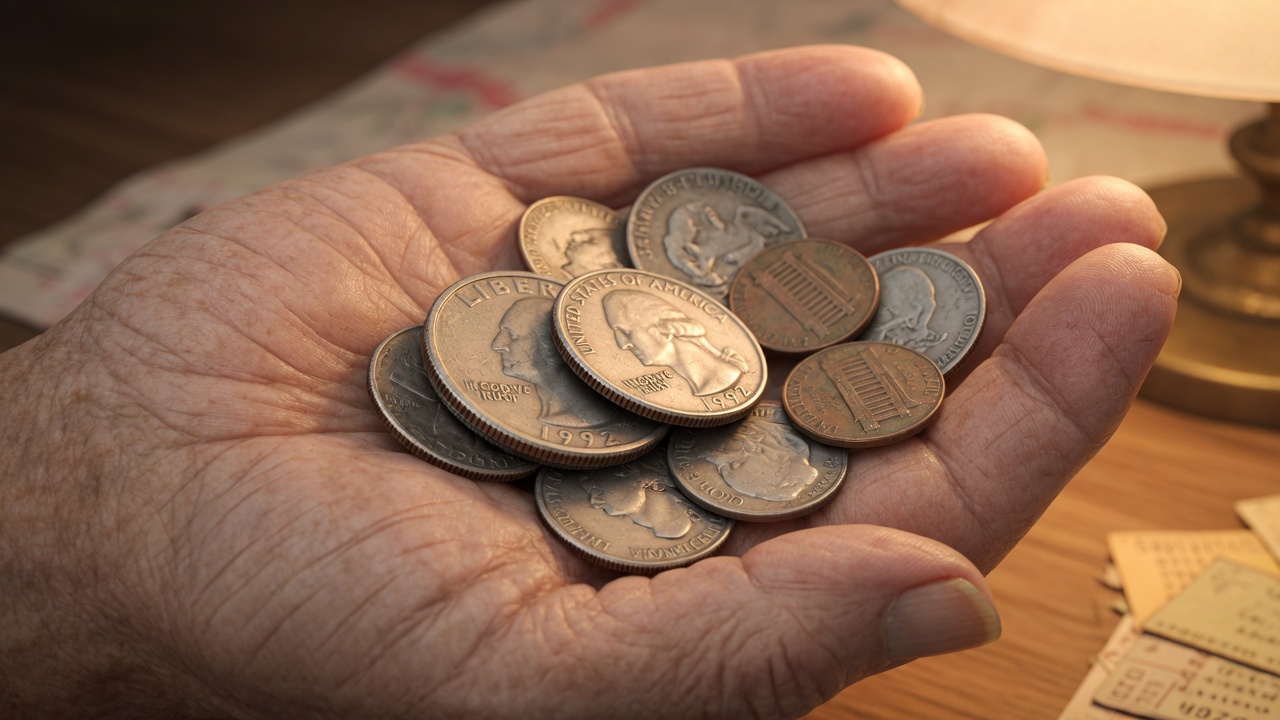
Think about the last time you reached into your pocket or purse for some loose change. Maybe you were paying for a morning coffee, grabbing a newspaper, or just clearing out your coat at the end of a long day. Without even looking, your fingers likely felt the familiar, comforting weight of quarters and dimes. Your fingertips instantly registered those tiny, rough ridges running all along the outside edges.
They feel completely normal to us, don’t they? They are just a standard part of what makes a coin feel like a coin. But have you ever stopped to wonder why those little grooves are there in the first place? As it turns out, those small ridges are not just a decorative choice or a random design fluke. They actually hold the secret to a gripping historical detective story. It is a tale filled with daring thieves, a collapsing economy, and a brilliant rescue by one of the most famous scientists in human history.
The Days When Money Was Made of Solid Treasure
To understand why our modern coins look the way they do, we must take a quick trip back in time. Let’s travel back about three or four hundred years. Back then, money did not get its value from a government promise or a digital bank account. A silver coin consisted of solid silver, and a gold coin was pure, heavy gold. The value of the money tied directly to the precious metal you could hold in the palm of your hand.
While this system sounded wonderful in theory, it created a massive temptation for folks looking to make a quick, dishonest buck. The edges of these ancient coins were completely smooth. They were also slightly uneven because workers stamped them by hand. Criminals soon realized they could exploit this system without getting caught. They began practicing a highly illegal art known as “coin clipping.”
The Art of the Sneaky Shaving
Imagine coming home after a long day of work with a handful of silver coins. Before you went out to spend them, you might take a sharp pair of shears or a heavy metal file. You would carefully shave off just a tiny, microscopic sliver of silver from the smooth outer rim of each coin.
Because the coins already had irregular shapes, a tiny bit of missing metal from the edge did not look obvious at all. The coin still looked mostly round, so merchants readily accepted it at full face value. But here is where the trick became incredibly profitable. The thief would save all those tiny silver shavings in a jar. Once they collected enough, they melted the precious metal down into a solid bar and sold it on the black market. It seemed like the ultimate victimless crime.
One person clipping a single coin did not seem like a big deal. However, human nature being what it is, the practice spread like wildfire. Soon, thousands of people across Europe secretly filed down their money. Before long, the collective damage became devastating to the entire continent.
A Financial Crisis That Threatened to Collapse Entire Nations
As the decades rolled on, the situation turned from a minor nuisance into a full-blown national emergency. By the late 1600s, the coins circulating through the markets of London were horribly deformed, thin, and lightweight. Some coins had lost nearly half of their original weight to the shears of greedy clippers.
This created a massive crisis of trust, which always damages an economy the fastest. Merchants started refusing to accept coins at their face value. If a loaf of bread cost one silver shilling, a baker might demand two or three shillings instead. They did this simply because the coins were so thin and lacked the proper amount of actual silver.
People grew angry, prices skyrocketed, and the entire monetary system faced total collapse. The government knew it had to act fast. Unfortunately, they tried the only thing they knew how to do at the time: they cracked down with absolute brute force.
When Harsh Punishments Weren’t Enough
In an effort to terrify citizens into honesty, authorities made coin clipping a crime of high treason. The punishments were unimaginably severe. If the law caught you with a pair of shears and a jar of silver shavings, you faced the death penalty.
Yet, despite the terrifying threat of the gallows, the clipping continued. The potential reward was simply too high. Furthermore, the smooth edges of the coins made the crime far too easy to commit. It was also almost impossible to prove once the coin left the thief’s hands. It became glaringly obvious that the government could not solve a design problem with violence. They did not need tougher laws; they needed a smarter design.
Enter a Genius: How Isaac Newton Saved the Day
This is where our story takes a truly fascinating turn. It introduces a historical character you likely remember from your school days. In 1696, the government turned to one of the most brilliant minds of the era to help solve the currency crisis: Sir Isaac Newton.
While we usually associate Newton with sitting under apple trees and discovering gravity, he also took on a new role. The crown appointed him as the Warden of the Royal Mint in London. This was not just an honorary, cushy title for the famous scientist. Newton took his job incredibly seriously. He treated the currency crisis like a complex scientific puzzle that needed an elegant, foolproof solution.
Newton spent days studying the problem. He analyzed how workers made coins and how thieves operated. He realized that as long as the edges of a coin remained smooth and plain, criminals would always find a way to shave them down. The solution had to sit directly within the physical structure of the money itself.
Newton’s Fight Against the Counterfeiters
Newton spearheaded a massive technological overhaul at the Royal Mint. He introduced new, heavy machinery that could strike coins with incredible precision. Most importantly, he mandated a brilliant new design choice. Every high-value gold and silver coin had to feature a highly specific pattern of tiny, vertical grooves pressed directly into the outer rim.
This clever design feature is known technically as a “reeded edge.” The brilliance of Newton’s idea lay in its absolute simplicity. If a coin had a neat, uniform pattern of ridges wrapping around its entire circumference, any attempt to file or clip the edge would instantly destroy the pattern.
A merchant could simply glance at the edge of a coin or run their thumb along it. If the ridges felt smooth, uneven, or missing entirely, the merchant knew instantly that someone had tampered with the coin. Just like that, the crime of coin clipping wiped out almost overnight. Trust returned to the economy, and the money system was saved.
Why Do We Still Have Ridges in the Digital Age?
Now, you might be sitting there thinking, “That is a lovely history lesson, but we don’t use real gold and silver coins anymore. Why do my quarters and dimes still have those little ridges today?”
It’s a great question. Today, factories make our coins from cheap base metals like copper and nickel. Nobody is going to sit in their living room with a metal file trying to shave three cents’ worth of nickel off a quarter. Yet, even though the original threat of coin clipping vanished long ago, those tiny ridges survived into the 21st century for some surprisingly practical modern reasons.
Let’s look at why this centuries-old design still helps us in our daily lives:
- Accessibility and Independence: For individuals who are blind or visually impaired, those tiny ridges are an absolute lifesaver. By keeping the edges of dimes and quarters rough, while keeping pennies and nickels completely smooth, the government allows people to easily identify exactly what denomination they are holding purely by touch.
- Vending Machine Technology: When you drop a coin into a vending machine, an arcade game, or a parking meter, the machine doesn’t just look at the size of the coin. Sophisticated internal sensors use the physical ridges to help verify that the coin is genuine and not a fake slug or a foreign piece of metal.
- A Friendly Grip: From a purely tactile standpoint, those ridges make coins much easier to handle. They provide a little bit of friction, making it simpler to pick a coin up off a flat counter or slide it out of a tight wallet without it slipping from your fingers.
- The Power of Tradition: Human beings are creatures of habit. We have been using ridged quarters and dimes for hundreds of years. If the government suddenly started making smooth quarters, they would feel strange, cheap, and somehow fake to us. We expect our high-value coins to have that classic texture.
The Tale of Two Smooth Coins: Pennies and Nickels
You might also wonder why pennies and nickels managed to escape Isaac Newton’s clever design update. If you check your pockets right now, you’ll confirm that the edges of our one-cent and five-cent pieces are completely smooth.
The explanation for this comes down to simple economics. Back when coins contained precious metals, the mint made pennies and nickels out of much cheaper materials, like copper. They simply weren’t valuable enough to justify the immense effort of clipping. A thief would have to spend hours filing down hundreds of pennies just to get a few cents’ worth of copper shavings. Because the risk far outweighed the reward, these lower-value coins kept their smooth edges, and they have stayed that way ever since.
A Little Piece of History Right in the Palm of Your Hand
It is genuinely remarkable to think about how much hidden history sits tucked away in the mundane objects we use every single day. The next time you stand at a checkout counter, wait at a laundromat, or pull some loose change out of your couch cushions, take a brief moment to look closely at the edge of a quarter.
Run your fingernail along those tiny, precise ridges. You aren’t just holding a piece of metal worth twenty-five cents; you are holding a direct, physical link to a brilliant invention from the 1600s. You are touching a design feature that Sir Isaac Newton personally championed to defeat clever thieves and rescue an entire empire from financial ruin.
In our modern world of credit cards, smartphone payments, and digital banking, physical coins might feel a bit like relics of a bygone era. But they are also beautiful, enduring pieces of human ingenuity. They have quietly survived for centuries, serving us faithfully every single day in ways we rarely ever stop to notice.
Important Note:
This article is written for entertainment and general informational purposes only. The stories, ideas, and information shared here are meant to be interesting, thought-provoking, or enjoyable to read.
Nothing in this article should be considered professional advice of any kind — whether medical, legal, financial, psychological, or otherwise. The content on this blog is not a substitute for consulting with qualified professionals.
Always do your own research and speak with a trusted expert before making any important decisions in your life. The author and publisher of this blog are not responsible or liable for any actions you take (or do not take) based on the information in this article.
Information and stories may be based on personal experiences, public sources, or creative interpretation. While we aim to share content that is accurate and respectful, we cannot guarantee that everything will be completely up to date or suitable for every reader’s situation.
By continuing to read this blog, you understand and agree that this content is for entertainment only.
Leave a Reply