Have You Tried the Hidden Object Puzzle That Has Everyone Scratching Their Heads?
Have you ever spent a solid ten minutes looking for your reading glasses, only to realize they were resting comfortably on top of your head? Or perhaps you have searched the entire refrigerator for a jar of mustard that was sitting right in the front row. We have all been there. Our brains are wonderfully complex, but they can play some funny tricks on us when we are looking for something specific.
That is exactly why visual brain teasers are so incredibly popular right now. They take that everyday experience of “missing what is right in front of us” and turn it into a fun, relaxing game. Today, we are looking at a hidden object puzzle that has been making the rounds on the internet and sparking some remarkably passionate debates.
At first glance, it seems like child’s play. You are given a charming illustration of a bedroom and asked to find four everyday items. Easy, right? Well, most people can find three of them in a matter of seconds. But the fourth object? That is where things get genuinely tricky. It is stumping folks left and right, causing them to squint, zoom in, and wonder if their eyes are playing tricks on them.
Grab a comfortable seat, pour yourself a warm cup of tea or coffee, and let’s dive into this delightfully frustrating puzzle. We will walk through it together, step by step.

The Magic of a Good Brain Teaser
Before we break down the challenge itself, let’s talk about why we love these puzzles so much. If you grew up looking forward to the Sunday morning newspaper, you probably remember spreading the pages out on the kitchen table to tackle the crosswords, the jumbles, or those classic “spot the difference” drawings. There was a unique kind of quiet joy in taking a few moments for yourself to solve a little mystery.
As it turns out, taking time for these puzzles is actually fantastic for our minds. Engaging in a brain teaser is like taking your brain for a brisk morning walk. It encourages cognitive flexibility, sharpens our attention to detail, and even gives us a little boost of dopamine—the “feel-good” chemical—when we finally spot the solution.
The puzzle we are looking at today is a brilliant example of this. It does not just test your eyesight; it tests your expectations. It asks you to look beyond the obvious and see the world in a slightly different way. Let’s take a look at the scene.
Setting the Scene: A Cozy Night In
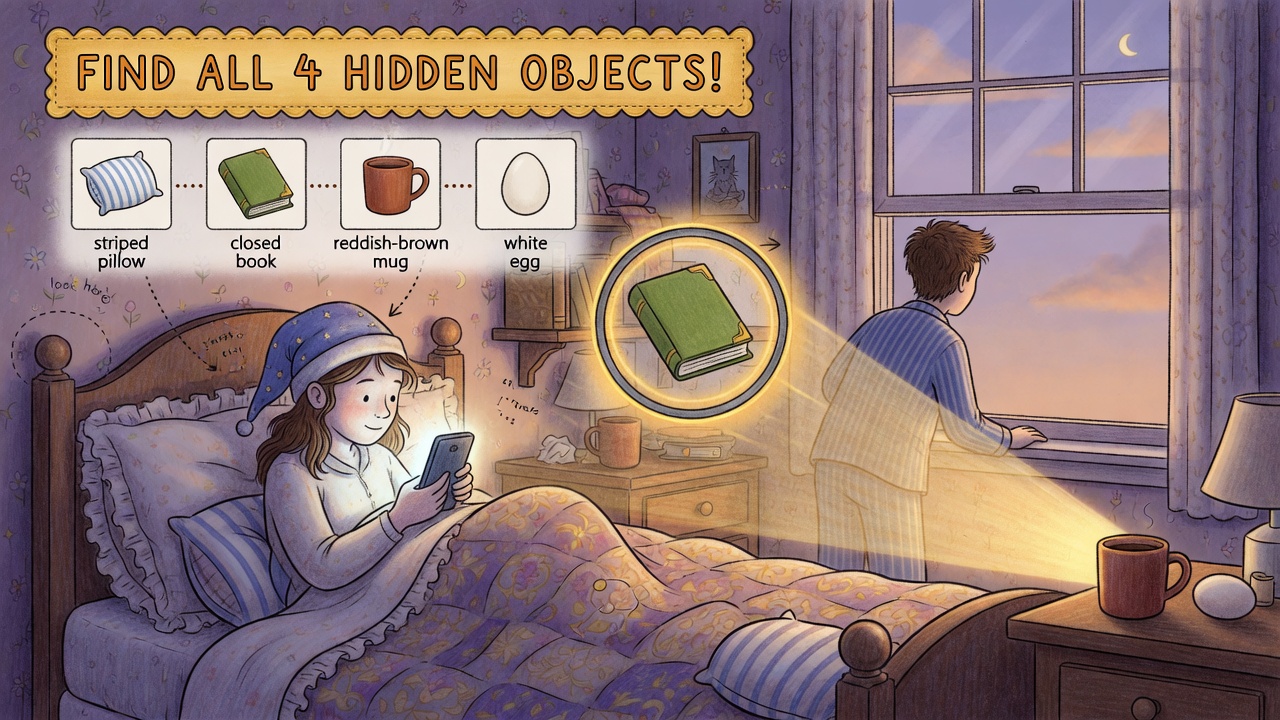
The illustration in question presents a beautifully drawn, cozy bedroom scene at night. It is the kind of room that makes you want to curl up with a good novel. A man is standing beside a large window, looking thoughtfully out into the evening, while a woman sits comfortably in bed, illuminated by the soft glow of her smartphone.
Scattered around the room are all the standard things you would expect to see. There is a sturdy wooden bed frame, a patterned blanket, a bedside table, shelves lined with books, and a charming little lamp. The room feels lived-in and warm.
Your task is to find four specific items that are shown in a little key at the top of the image:
- A striped pillow
- A book
- A cup
- An egg
Let’s break down the search, starting with the easiest finds and working our way up to the one that is making everyone pull their hair out.
1. Finding the Pillow: A Gentle Warm-Up
Every good puzzle gives you an easy victory to build your confidence, and in this image, that victory is the pillow. When you glance at the key, you see a distinctly striped pillow. Naturally, your eyes dart straight to the bed.
Sure enough, resting right behind the woman on the mattress, there are several cushions. Among them, prominently displayed, is a pillow with a pattern that perfectly matches the one you are looking for. There is no trickery here, no hidden agenda. It is exactly where a pillow belongs, doing exactly what a pillow does.
Finding this first item gives your brain a nice little rush of satisfaction. You can mentally check it off the list. One down, three to go!
2. Spotting the Book: A Lesson in Looking Closer
Next on our list is the book. This one requires a tiny bit more effort, but it is still quite manageable. The funny thing about the book in this puzzle is that you actually have a few options to choose from.
If you scan the room, you will notice that this couple clearly loves to read. There is a book resting casually on the purple blanket at the foot of the bed. If you look up, there are several more books lined up neatly on the wall shelf above the headboard.
However, if you want to be remarkably thorough, take a look over by the man standing near the curtain. Resting quietly on the windowsill is another small book. This little detail is wonderful because it rewards the people who take the time to scan the entire image, rather than just focusing on the center of the room.
Whichever one you spotted first, you can safely say you have found the book. We are halfway there!
3. Locating the Cup: Beware the Clever Decoy!
This is where the artist starts to play with our minds. When we are told to look for a cup, our brains immediately start searching for a typical morning mug. And right there, sitting on the bedside table next to the lamp, is a bright green mug.
“Found it!” you might think, ready to move on. But wait just a moment.
Take a closer look at the key at the top of the puzzle. The cup you are specifically supposed to find is not green. It is a reddish-brown mug with a distinct handle. The artist placed that green mug on the nightstand deliberately as a decoy. It is a classic misdirection technique designed to make you jump to conclusions.
If you ignore the green decoy and keep searching, you have to cast your gaze a little higher. Look up at that wall shelf above the bed again, nestled right between the books. There it is—a reddish-brown mug that identically matches the one in the key. It is tucked away in a spot where you wouldn’t necessarily expect a cup to be resting.
Spotting this requires patience and a willingness to double-check your own assumptions. If you caught the decoy and found the real cup, give yourself a well-deserved pat on the back.
4. The Elusive Egg: The Ultimate Brain Bender
Now we arrive at the main event. The pillow, the book, and the cup were all fairly straightforward. They were literal objects sitting in the room. But the fourth item on the list is an egg.
If you are like most people, you probably scanned the bedside table, looked under the bed, checked the windowsill, and even squinted at the woman’s hands to see if she was inexplicably holding an egg while browsing her phone. Nothing. There is no literal egg sitting anywhere in this cozy bedroom.
This is the part of the puzzle that has sparked so much conversation online. People stare at the screen for minutes on end, completely baffled. Some even claim the puzzle is broken or that the artist forgot to draw it.
But the artist didn’t forget. They just changed the rules of the game.
Instead of drawing an actual breakfast egg, the artist hid the shape of an egg within the architecture and furniture of the room. When you stop looking for a physical egg and start looking for an egg-shaped silhouette, the room suddenly transforms.
Take a close look at the wooden cabinet beside the bed. Carved into the front drawer is a decorative oval ornament. It strongly resembles the shape of an egg. But wait, there is an even better candidate!
Look at the lamp sitting on that very same bedside table. Focus on the central stand of the lamp. The ornamental section right in the middle is an elongated, smooth oval. It mimics the exact curve, width, and height of an egg. The artist used the lines of the lamp to draw the hidden object in plain sight.
This brilliant little trick is what makes the puzzle so memorable. It forces us to shift our perspective from looking for “things” to looking for “shapes.”
The Fascinating Science Behind Why We Get Stumped
You might be wondering why something as simple as a hidden egg shape can fool so many smart, observant adults. It all comes down to a fascinating psychological quirk known as selective attention.
Our brains are incredibly efficient machines. Every single second, our eyes take in millions of pieces of visual information. If our brains tried to process every single detail with equal importance, we would be completely overwhelmed. To cope with this, our minds create shortcuts.
When you read the word “egg,” your brain instantly pulls up a mental file of what an egg looks like. It expects a small, white or brown, fragile object sitting in a carton, on a plate, or perhaps in a bird’s nest. Your brain is actively filtering the image, looking only for things that match that specific mental file.
Because the lamp stand is yellow and functions as a light fixture, your brain immediately categorizes it as “lamp” and moves on. It literally filters out the egg shape because it contradicts the context of the room. You are experiencing a mild form of “inattentional blindness.” You are looking right at the answer, but your brain refuses to see it because it is not what it expects.
This happens in our daily lives all the time! It is the exact reason why we cannot find the car keys when they are sitting on the hallway table next to a stack of mail, or why we miss a typo in an email we have proofread three times. Our brains see what they expect to see.
When you finally break through that mental shortcut and spot the shape hidden in the lamp, you experience a wonderful “Aha!” moment. Your brain forms a new connection, which is incredibly healthy for maintaining mental agility as we get older.
The Final Scorecard: How Did You Do?
Let’s do a quick recap of the final solutions to see how you fared against this viral challenge:
- The Pillow: Safely resting on the bed, right where it belongs.
- The Book: Hidden in plain sight on the blanket, the shelf, and the windowsill.
- The Cup: Tucked away on the top shelf, cleverly bypassing the green decoy mug on the table.
- The Egg: Masterfully disguised as the decorative oval center of the bedside lamp.
If you managed to find all four before reading the explanations, you should be genuinely proud. You have an exceptionally sharp eye for detail and a beautifully flexible mind that isn’t easily fooled by visual tricks.
If the egg completely stumped you, do not worry for a second. You are in the majority! The puzzle was specifically designed to use our own brain’s efficiency against us. The fun is not necessarily in getting it right instantly, but in the journey of discovering how our perception works.
Visual puzzles like this one are a wonderful reminder that there is often more to a situation than meets the eye. Sometimes, all it takes to solve a stubborn problem is to step back, take a deep breath, and look at things from a completely different angle.
Why not share this article with your friends, your spouse, or your grandkids? Let them stare at the screen for a few minutes and see if they fall for the green cup decoy, or if they can spot the cleverly disguised lamp-egg. It is a wonderful way to spark a conversation and share a few laughs over a shared challenge.
Keep your eyes peeled, keep challenging your mind, and most importantly, never lose your sense of curiosity!
Important Note:
This article is written for entertainment and general informational purposes only. The stories, ideas, and information shared here are meant to be interesting, thought-provoking, or enjoyable to read.
Nothing in this article should be considered professional advice of any kind — whether medical, legal, financial, psychological, or otherwise. The content on this blog is not a substitute for consulting with qualified professionals.
Always do your own research and speak with a trusted expert before making any important decisions in your life. The author and publisher of this blog are not responsible or liable for any actions you take (or do not take) based on the information in this article.
Information and stories may be based on personal experiences, public sources, or creative interpretation. While we aim to share content that is accurate and respectful, we cannot guarantee that everything will be completely up to date or suitable for every reader’s situation.
By continuing to read this blog, you understand and agree that this content is for entertainment only.
Leave a Reply