The Simple Joy of a Morning Walk in the Woods
There is something deeply grounding about a morning walk through an old, deeply shaded forest. If you enjoy hiking or just taking casual strolls in nature, you already know exactly what I mean. The air feels different there. It carries that rich, unmistakable scent of damp soil, heavy moisture, and decaying wood. It is a quiet world, far removed from the noise of our busy daily lives. When you step beneath a canopy of towering trees, time seems to slow down just a little bit.
For many of us, especially as we get older, these moments in nature become cherished rituals. The soft rhythm of boots crunching on fallen leaves and the gentle shifting of sunlight through the branches create a deeply relaxing environment. On one such beautiful morning, a father and his young son, Leo, decided to spend some quality time together. They left their screens behind and set out on a narrow, winding trail through an ancient stretch of old-growth woodland.
Walking with a child or grandchild in the woods is a wonderful experience. Their curiosity is boundless. They notice the little things we often walk right past—a peculiarly shaped stone, a hollowed-out tree trunk, or the sudden, quick movement of a squirrel darting up an oak tree. Leo was doing exactly what young explorers do best: walking just a few steps ahead, inspecting every interesting branch, and turning the hike into a grand adventure.
When the Peaceful Woods Turn Eerie
At first, the forest offered nothing but peace. The only sounds were the distant calls of native birds and the occasional rustling of small wildlife in the brush. Everything felt safe, familiar, and deeply calming. Because of this, the father and son maintained a relaxed, easygoing pace, venturing further into the heart of the woodland.
However, the atmosphere shifted in an instant. Suddenly, little Leo stopped dead in his tracks.
He didn’t call out, and he didn’t point. Instead, his entire body went completely stiff. Slowly, he took a hesitant step backward, reaching out to grip his father’s sleeve. The sudden change in the boy’s body language was unmistakable. It was a reaction driven by pure, unfiltered uncertainty and a genuine sense of fear.
A Discovery Straight Out of a Sci-Fi Movie
Any parent or grandparent knows that immediate spike of adrenaline when a child is frightened. The father quickly stepped forward, following Leo’s wide-eyed gaze to see what had captured his attention. There, near the dark, mossy base of a massive tree, something very unusual was emerging from the damp forest floor.
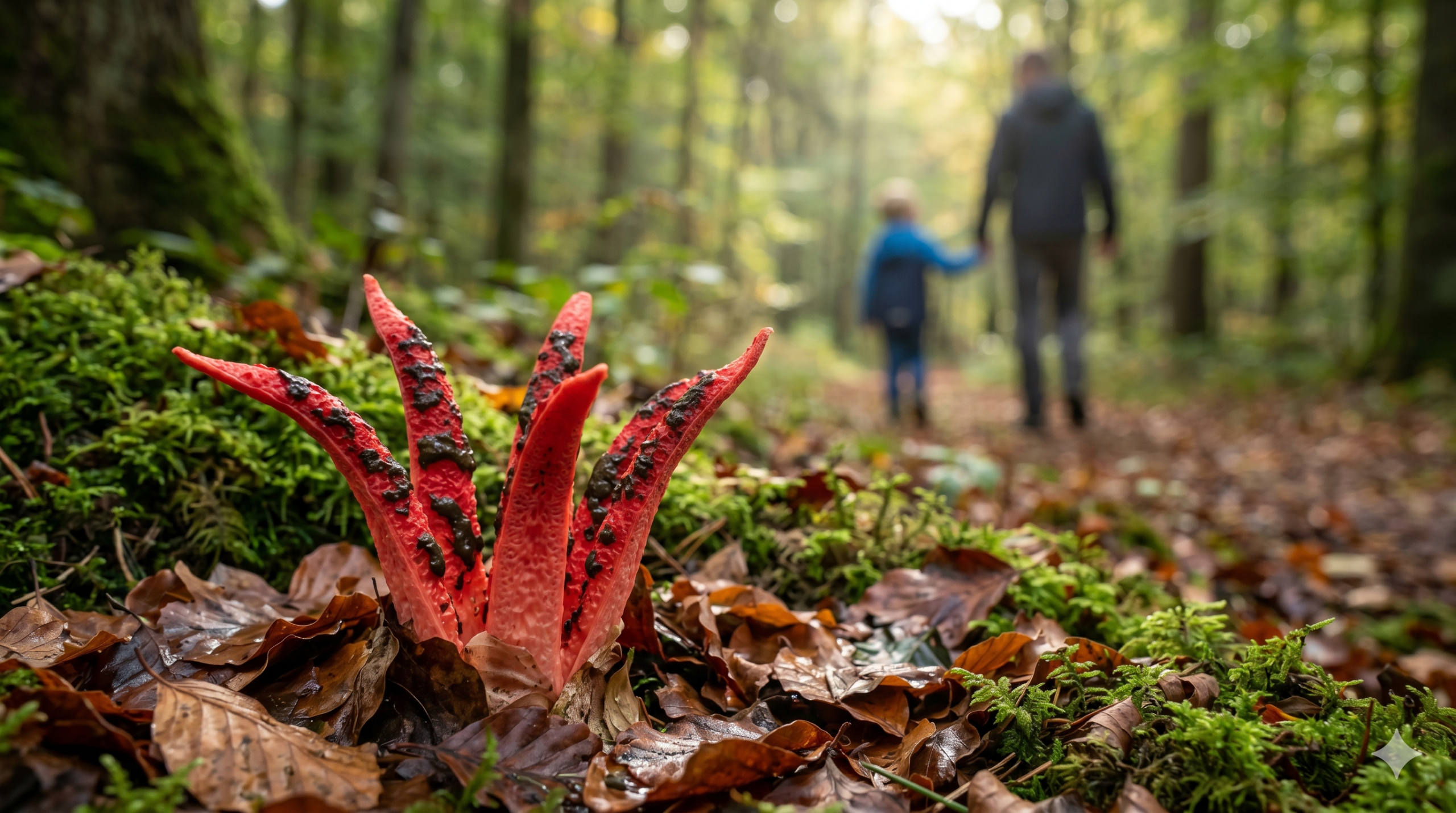
From a few feet away, it didn’t look like a plant. It didn’t look like an animal, either. Partially hidden among the decaying brown leaves, several elongated, bright red shapes were thrusting upward from the dirt. They looked fleshy, bizarre, and entirely out of place in the quiet green and brown landscape of the woods.
It is entirely natural that their first reaction was concern. When we are deep in a quiet forest, unfamiliar things can easily seem a bit threatening. Shadows and silence have a way of playing tricks on our minds. As they cautiously took a step closer, they realized the structure wasn’t man-made, nor was it an animal trap. It was clearly something organic. Yet, with its creeping red tentacles, it looked more like an alien creature from a science fiction movie than anything you would expect to find on a casual morning hike.
Solving a Creepy Woodland Mystery
The father stood there for a moment, his protective instincts on high alert. Was it dangerous? Was it a poisonous plant? In unfamiliar environments, it is incredibly common for us to misinterpret rare, strange-looking natural organisms as severe hazards.
After a few moments of careful observation, the initial shock began to wear off, and a strong sense of curiosity took over. We are lucky to live in an age where answers are usually right in our pockets. The father pulled out his smartphone, snapped a quick photo of the bizarre red tentacles, and began searching for clues.
It didn’t take long for the search results to populate. Pictures of the exact same bizarre, finger-like structures flooded his screen. As they read through the descriptions together, the eerie mystery of the forest floor was finally solved.
Meet the “Devil’s Fingers” Mushroom
What the father and son had stumbled upon was a highly unusual type of fungus scientifically known as Clathrus archeri. If you think the scientific name is a mouthful, its common names are much more descriptive. It is widely known as “Devil’s fingers” or the “octopus stinkhorn.”
Despite its terrifying appearance, this fascinating fungus is a natural marvel. Originally native to Australia and New Zealand, it has slowly made its way across the globe over the last century. Interestingly, historians and botanists believe the spores were inadvertently brought to Europe during the First World War, hitching a ride on military supplies and soldiers’ boots. Today, it can be found in various woodland environments across Europe, North America, and parts of Asia.
Like many unusual mushrooms, Devil’s fingers thrive in moist, shaded areas. They grow naturally on decaying organic matter, such as old tree stumps, heavy leaf litter, and nutrient-rich soil. While they might look like something designed to frighten hikers, they are actually hard at work performing a vital job for the environment.
Why Does It Look (and Smell) So Awful?
Nature rarely does things by accident. The creepy appearance of the Devil’s fingers fungus is actually a brilliant evolutionary strategy. To fully appreciate this weird woodland oddity, you have to understand its incredibly bizarre life cycle.
- The “Witches Egg” Stage: The fungus does not start out looking like creepy red fingers. It begins its life as a grayish, gelatinous, egg-like sphere partially buried in the dirt. At this stage, it goes almost completely unnoticed by passersby.
- The Eruption: As the fungus matures inside this protective sac, it eventually bursts open. This is when the magic—or the horror, depending on your perspective—happens.
- The Unfolding: Between four and seven elongated structures push their way out of the egg. As they reach upward, they unfold like the tentacles of an octopus, revealing a vivid, striking red and pink coloration.
The vibrant color makes them stand out sharply against the dull backdrop of the forest floor. But the strange appearance is only half of the story. If the father and son had leaned in a little closer, they would have noticed something else entirely: the smell.
A Fragrance Only a Fly Could Love
The inner surface of those bright red “fingers” is coated with a sticky, dark, olive-brown substance called gleba. This slimy material is packed full of the mushroom’s spores, which are absolutely essential for the fungus to reproduce and survive.
To spread these spores, the Devil’s fingers mushroom uses a brilliant, if somewhat disgusting, tactic. It emits a powerful, foul odor. People who have gotten close to it often compare the smell to decaying meat or rotting garbage. While this scent might make a human turn around and walk the other way, it is absolutely irresistible to flies and other insects.
Drawn in by the terrible smell, insects land on the sticky tentacles, thinking they have found a delicious meal. When they realize there is no food to be had, they fly away. However, the sticky, spore-filled gleba attaches itself to their legs and bodies. As the flies travel through the woods, they unintentionally carry the spores to brand-new locations, helping the mushroom spread and thrive.
A Bizarre but Completely Harmless Forest Friend
It is easy to understand why little Leo was so frightened when he first spotted the fungus. Bright red colors in nature often serve as a universal warning sign, signaling danger or poison. Combine that with a shape that looks like a hand reaching out from the grave, and you have a recipe for a good scare.
However, despite its aggressive appearance and terrible smell, Clathrus archeri is completely harmless to humans and animals. You cannot be poisoned just by standing near it, and it does not produce toxins that can harm you if you accidentally brush up against it. It simply wants to attract bugs, spread its spores, and quietly break down dead wood.
The Unsung Heroes of the Forest Floor
Encounters like this are wonderful reminders of how complex and diverse our natural world really is. Fungi are often the unsung heroes of the environment. Without them, our forests would be overwhelmed by dead leaves and fallen trees.
Mushrooms like Devil’s fingers play a critical ecological role. They are nature’s supreme recyclers. As they grow on decaying matter, they break down complex organic materials and return vital nutrients back into the soil. This process feeds the towering trees, the blooming wildflowers, and the entire ecosystem of the forest. Even decaying material, which we often view as the end of a life cycle, becomes the very foundation that supports new growth.
What We Can Learn from Nature’s Weirdest Creations
Armed with this fascinating new knowledge, the father and son looked at the fungus with entirely new eyes. The fear was completely gone. In its place was a shared sense of awe and curiosity. They stood safely at a distance, observing the bright red tentacles, pointing out the dark patches of spores, and marveling at the weird, wonderful ways nature finds to survive.
What started as a frightening moment turned into a beautiful, informal learning experience. It was a chance to teach a young boy that we shouldn’t always fear things just because they look different or strange. Sometimes, the most unusual things in life have the most important jobs to do.
As they finally turned and continued their hike, the woods felt a little bit different to both of them. Their awareness had shifted. Instead of just looking straight ahead, they found themselves scanning the ground, looking for tiny, overlooked organisms hiding among the roots and moss. They realized that a forest is much more than just a collection of trees; it is a vibrant, interconnected community filled with bizarre adaptations and hidden life cycles.
Walking back home, the peaceful rhythm of the forest returned. The morning hike was a success, leaving them with a great story to tell and a newfound respect for the natural world. Ultimately, their experience serves as a lovely reminder for all of us: nature can seem mysterious, and sometimes even a little scary, at first glance. But when we take the time to look closer and understand how things work, we usually find that even the strangest things belong exactly where they are.
Important Note:
This article is written for entertainment and general informational purposes only. The stories, ideas, and information shared here are meant to be interesting, thought-provoking, or enjoyable to read.
Nothing in this article should be considered professional advice of any kind — whether medical, legal, financial, psychological, or otherwise. The content on this blog is not a substitute for consulting with qualified professionals.
Always do your own research and speak with a trusted expert before making any important decisions in your life. The author and publisher of this blog are not responsible or liable for any actions you take (or do not take) based on the information in this article.
Information and stories may be based on personal experiences, public sources, or creative interpretation. While we aim to share content that is accurate and respectful, we cannot guarantee that everything will be completely up to date or suitable for every reader’s situation.
By continuing to read this blog, you understand and agree that this content is for entertainment only.
Leave a Reply