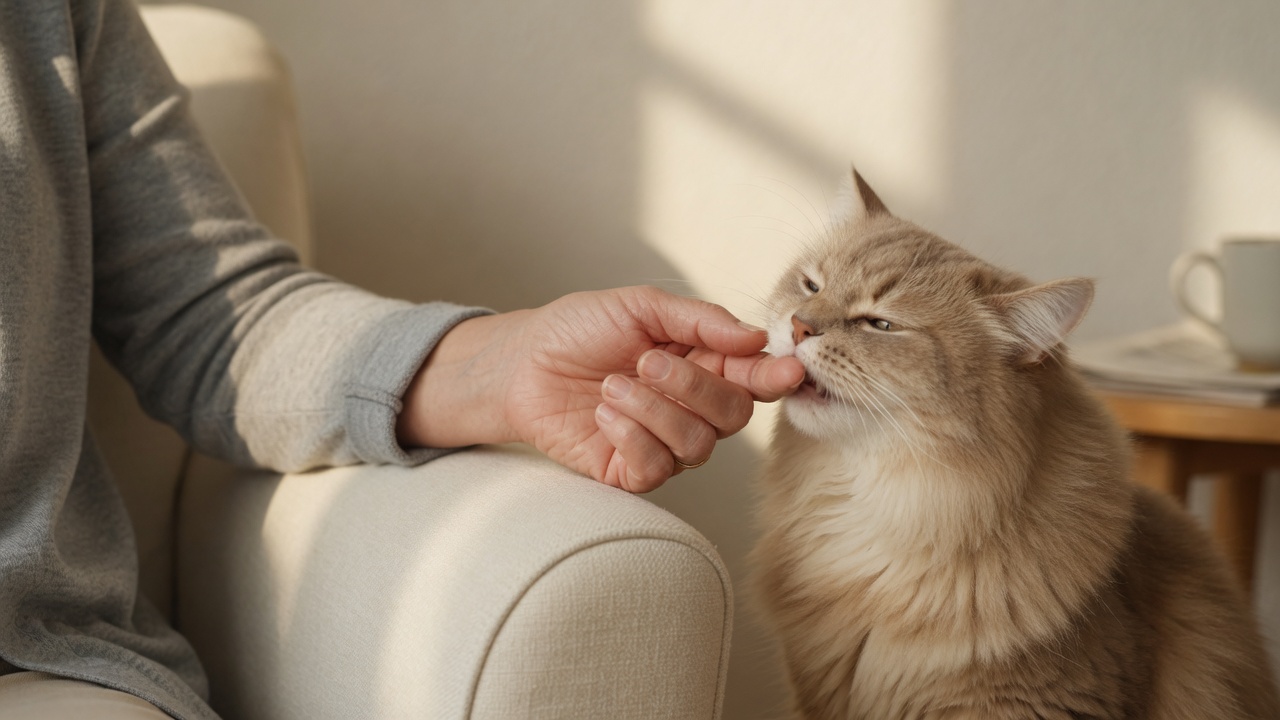
The Mystery of the Sudden Feline Nibble
Anyone who has shared their home with a feline friend knows just how wonderfully quirky they can be. You could be sitting in your favorite armchair, enjoying a quiet afternoon with a cup of tea, while your cat curls up on your lap. They are purring like a tiny motorboat, their eyes are half-closed in pure contentment, and you are gently stroking their soft fur. It is a beautiful, peaceful moment.
Then, out of absolutely nowhere, it happens. They turn their head and give your hand a sudden, sharp little bite.
It always takes us by surprise, doesn’t it? One minute they are your sweetest companion, and the next, they are acting like a wild little tiger. If you have ever rubbed your hand and wondered, “Why on earth did my cat just do that?”, please know that you are certainly not alone. Cat behavior can often feel like a puzzle with missing pieces.
For many of us who have lived with cats for decades, we know that they do not communicate the way dogs or humans do. They have a rich, complex, and sometimes confusing language all their own. A bite is rarely just a bite. In the feline world, a nip can carry a whole conversation.
Let’s take a warm, careful look at what is really going on in your furry friend’s mind when they decide to give you a nibble. Here is what your cat might be trying to tell you, depending on the situation.
1. The “Love Bite”: A Strange Way to Say I Love You
If your cat really likes you, it is not unusual for them to give you a little nibble now and then. It might seem like a strange way to show affection, but in the cat world, this is a genuine compliment.
These gentle, soft bites usually happen when your cat is feeling deeply relaxed and content. You might notice them purring loudly, gently kneading your lap with their paws, or rubbing their cheeks against your hands. During these moments of closeness, they might take your finger or the soft part of your hand and give it a very gentle nip that does not break the skin.
Why do they do this? It actually goes back to their days as tiny kittens. Mother cats will often gently nip and groom their babies as a way to bond and show care. When your adult cat does this to you, it is their way of saying that you are a cherished member of their family. They feel entirely safe with you.
While a love bite is a sweet gesture, we all know they can still pinch a little bit! If it hurts, try not to pull away too quickly, as that might trigger a playful reaction. Just gently freeze, and your sweet companion will usually release their grip and go back to purring.
2. The “I Have Had Enough” Bite: Petting-Induced Overstimulation
This is perhaps the most common reason our beloved older cats suddenly turn on our hands. You are petting them, they are enjoying it, and then—snap! This behavior is known by veterinarians as petting-induced aggression, but “overstimulation” is a much better way to describe it.
To understand this, we have to think about how a cat experiences the world. A cat’s hair follicles are incredibly sensitive. Think about how it feels when someone lightly tickles your arm or plays with your hair. At first, it feels wonderful and relaxing. But if they keep doing it in the exact same spot for ten minutes straight, it starts to feel irritating, overwhelming, and even a little uncomfortable.
Your cat experiences the same thing. They have a specific threshold for touch. When that threshold is crossed, the wonderful feeling of being petted suddenly turns into a stressful sensation. Because they cannot simply tell us, “Please stop, my back is getting too sensitive,” they use their teeth to communicate.
The bite is their way of putting up a stop sign. It is not done out of anger or malice; it is simply a boundary being set. Learning to respect that boundary will make both you and your cat much happier.
How to Spot the Warning Signs
The good news is that overstimulation bites rarely happen entirely without warning. Our cats actually give us plenty of subtle signals that they are reaching their limit. We just have to know what to look for. Before you get bitten, watch out for these tell-tale signs:
- The Tail Thump: If your cat’s tail was softly swaying but suddenly starts aggressively thumping or flicking against the couch, they are getting annoyed.
- Skin Twitching: Watch the fur along their back. If it starts to ripple or twitch, their nerve endings are becoming overloaded.
- Ears Shifting: A happy cat has relaxed ears facing forward. An irritated cat will turn their ears backward or flatten them like airplane wings.
- Dilated Pupils: If their pupils suddenly become very large and dark, they are shifting from a state of relaxation to a state of high alert.
- Stopping the Purr: If the motorboat sound suddenly cuts out, it is a clear sign the relaxing moment has ended.
If you see any of these signs, simply stop petting them. Let them rest on your lap peacefully without touching them. They will deeply appreciate that you listened to their polite requests before they had to resort to a bite.
3. The Playful Predator: When Your Hand Looks Like Lunch
Even if your cat spends their golden years napping in the sunbeams on your living room floor, deep down, they are still a tiny lion. Cats are naturally playful creatures with deeply ingrained hunting instincts. They need space and opportunity to explore their world and burn off energy.
Sometimes, cats will bite during play. This is especially true if, when they were kittens, people used their bare hands or fingers to wrestle with them. While it is incredibly cute when a tiny, fluffy kitten attacks your fingers, it is much less charming when a fully grown ten-pound cat does the same thing!
If your cat pounces on your ankles as you walk down the hallway, or grabs your hand and does “bunny kicks” with their back legs, they are engaging in predatory play. They are not genuinely trying to hurt you; they are just practicing their hunting skills, and unfortunately, you are the closest target.
To fix this, we need to redirect that wonderful feline energy. Never use your hands or feet as toys. Instead, keep a few wand toys or stuffed mice nearby. When your cat gets that wild, playful look in their eye, drag a toy across the floor to give them something appropriate to hunt. It is a brilliant way to keep them active and keep your hands completely safe.
4. “Ouch, Please Stop”: When Biting Means Your Cat is in Pain
As we get older, we all deal with our fair share of aches, pains, and stiff joints. Our furry companions are no different. For those of us sharing our lives with senior cats, it is vital to remember that sudden behavioral changes can often be linked to hidden health issues.
Cats are masters at hiding pain. In the wild, showing weakness makes an animal a target, so our house cats have inherited the instinct to suffer in silence. If your normally sweet and cuddly cat suddenly starts biting when you try to pick them up or brush them, they might be trying to protect a painful area.
Arthritis is very common in older cats, particularly in their hips, lower back, and elbows. A gentle pat on the back might send a shock of pain through an arthritic joint. Dental disease is another major hidden culprit. If a cat has a painful tooth, they might become grumpy and quick to bite because their mouth is constantly throbbing.
If your cat’s biting behavior is completely new, or if they seem unusually lethargic, hide more often, or have changed their eating habits, a trip to the veterinarian is the very best next step. Your vet can check for underlying pain. Sometimes, a simple daily joint supplement or a dental cleaning can completely restore your cat’s sweet, affectionate personality.
5. Stress and Fear: The Anxious Biter
Cats thrive on routine. They love knowing exactly what is going to happen, when their meals will be served, and who is going to be in their home. Because they are so sensitive to their environment, sudden changes can cause a great deal of stress and anxiety.
If you have recently moved furniture around, brought a new pet into the home, or even just had noisy visitors over for the afternoon, your cat might feel overwhelmed. When cats are deeply frightened or stressed, they can lash out with a bite.
There is also a phenomenon known as “redirected aggression.” Imagine your cat is sitting in the window, looking out at the garden. Suddenly, a strange neighborhood cat strolls through your yard. Your cat gets incredibly territorial and agitated, but they cannot reach the intruder because of the glass. If you happen to walk by and gently touch your cat during this moment of high tension, they might turn around and bite you.
They are not truly angry with you; they are just so wound up by the outside cat that they react blindly to the nearest movement. In these moments, it is best to speak softly to them, dim the lights, and give them plenty of space to calm down on their own terms.
6. Teething Troubles: A Note for Kitten Owners
While many of us enjoy the calm companionship of older cats, some of us might be welcoming a rambunctious new kitten into our homes. If you have a kitten between three and six months old who is gnawing on your fingers constantly, they are likely teething.
Just like human babies, kittens lose their baby teeth to make way for their adult ones. Their gums become sore and tender, and chewing helps relieve the pressure. If your kitten is biting, gently swap your finger for a safe, soft chew toy. You can even put kitten chew toys in the refrigerator for a few minutes; the cool temperature feels wonderful on their sore gums.
How to Respond Safely and Kindly to a Bite
No matter the reason behind the bite, it is important to know how to handle it when it happens. Our initial human reaction is often to shout “Ouch!” and yank our hand away. However, pulling away quickly can actually trigger a cat’s instinct to chase and bite down harder.
Instead, try to keep your hand as still as possible. Gently push your hand slightly *towards* the cat. This confuses them, as prey always pulls away, never pushes forward. This gentle forward motion usually prompts them to loosen their jaw, allowing you to calmly remove your hand.
Never yell at, spray water at, or physically punish your cat. Cats do not understand punishment the way we do. Reacting with anger will only make them afraid of you, which damages the beautiful bond of trust you have spent years building.
Instead, withdraw your attention entirely. If your cat bites during play or petting, simply stand up and walk away. They will quickly learn that biting means the fun stops and their favorite human leaves. Positive reinforcement and patient redirection are always the most effective ways to guide their behavior.
Cherishing the Feline Connection
Living with a cat is a continuous journey of learning and understanding. It requires patience, keen observation, and a whole lot of love. When we take the time to figure out what our cats are trying to say, we deepen the special bond we share with them.
Whether it is a tiny, gentle love bite to say “you are doing great,” a quick nip to say “I am feeling overwhelmed,” or an accidental scratch during a playful hunting game, every action has a meaning. By paying attention to their subtle body language, respecting their boundaries, and ensuring they are healthy and pain-free, we can create a peaceful, joyful home for our feline companions.
So, the next time your sweet furry friend gives you a little surprise nip, do not take it personally. Take a breath, look at the situation through their eyes, and remember that they are just trying to talk to you in the only language they know. With a little understanding, you and your cat will be back to those peaceful, purring moments in no time.
Important Note:
This article is written for entertainment and general informational purposes only. The stories, ideas, and information shared here are meant to be interesting, thought-provoking, or enjoyable to read.
Nothing in this article should be considered professional advice of any kind — whether medical, legal, financial, psychological, or otherwise. The content on this blog is not a substitute for consulting with qualified professionals.
Always do your own research and speak with a trusted expert before making any important decisions in your life. The author and publisher of this blog are not responsible or liable for any actions you take (or do not take) based on the information in this article.
Information and stories may be based on personal experiences, public sources, or creative interpretation. While we aim to share content that is accurate and respectful, we cannot guarantee that everything will be completely up to date or suitable for every reader’s situation.
By continuing to read this blog, you understand and agree that this content is for entertainment only.
Leave a Reply