If you are anything like me, you probably have a designated “junk drawer” somewhere in your house. It is that magical, chaotic place where rogue rubber bands, expired coupons, and mystery keys go to live out their days. Every now and then, you might stumble across something that makes you pause. You hold it up, scratch your head, and wonder what on earth it belonged to.
Recently, I found exactly one of those objects while doing a bit of deep cleaning. I was sorting through an old box of family keepsakes. Tucked away at the bottom was a tiny, silver-colored metal piece. It was barely an inch long, featuring two small prongs and a miniature thumbscrew. To me, it looked vaguely like a component from a vintage bicycle. It could have passed for a delicate part from an old-fashioned clock. For a moment, I was completely stumped.
Then, like a flash of lightning, the memory hit me. This unassuming little metal gadget was not a spare part for a machine at all. It was actually one of the most vital, easily misplaced items from our childhood school days. It is the legendary compass lead holder from our classic geometry kits. If you went to school anywhere between the 1960s and the 1990s, you definitely had one of these in your backpack. You also probably spent half your time trying not to lose it.
—
Remembering the Glory Days of the Metal Geometry Tin
Finding that tiny piece of metal instantly transported me back in time. I could almost hear the chatter of a junior high math classroom. Do you remember the absolute thrill of getting your very own geometry set at the start of the school year? For many of us, it felt like a true rite of passage. It meant you were moving past simple addition and subtraction. You were finally entering the sophisticated world of angles, proofs, and technical drawings.
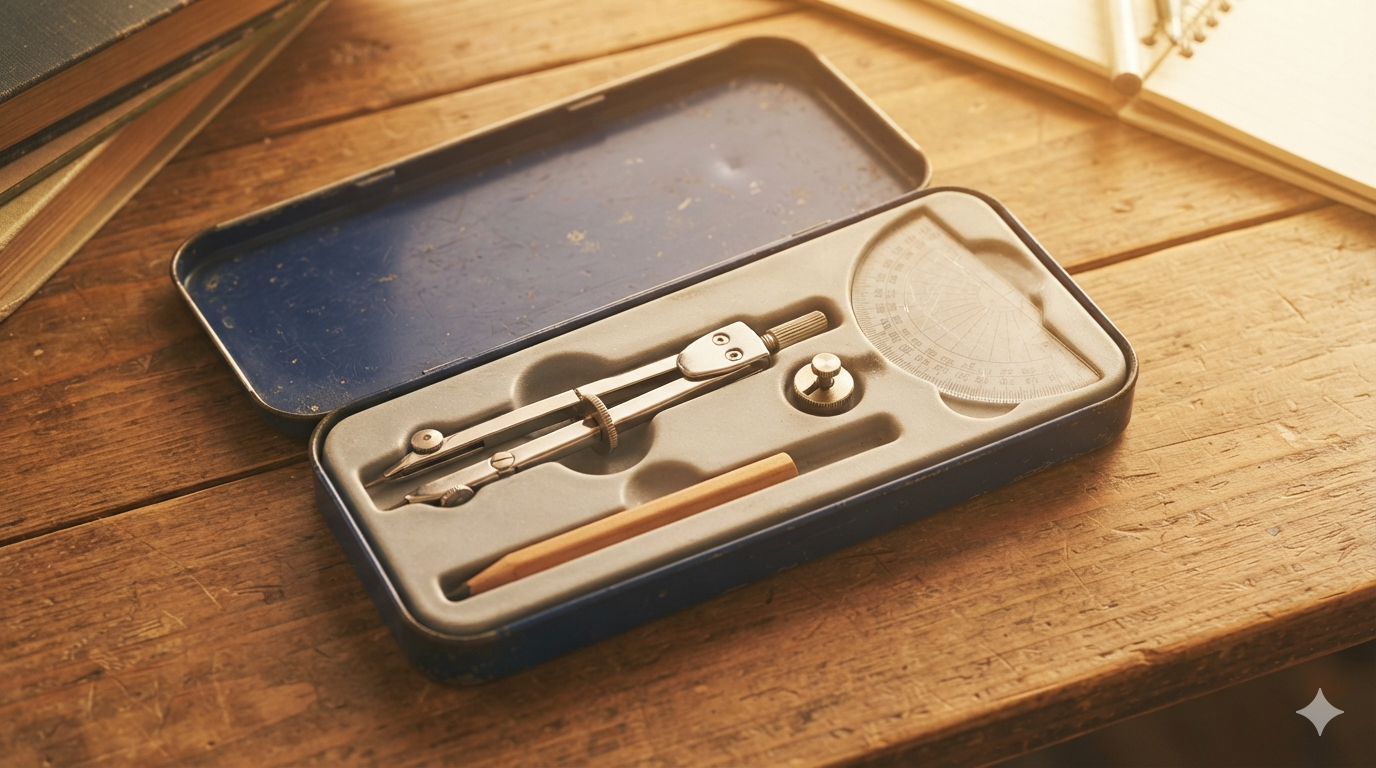
Those classic kits usually came in a wonderful little metal tin or a hard plastic case. Brands like Helix, Oxford, or Staedtler ruled the school yard. Opening that lid was a sensory experience all its own because of the loud snap. You were immediately greeted by the distinct, clean scent of fresh pencil shavings. The shiny gleam of chrome-plated tools always looked so professional. Even those clear plastic rulers and protractors felt special, though they got scratched up within the first week of class.
Inside the case, everything had its own dedicated molded slot. There was the long ruler, the 45-degree triangle, and the 60-degree triangle. You also received a semi-circular protractor, a small pink eraser, and a miniature pencil. That pencil always felt far too short for adult hands. Finally, you had the star of the show: the compass. Resting quietly in its own tiny indentation was our mystery object. The small lead holder attachment was the unsung glue holding the entire mathematical operation together.
—
What Exactly Did the Compass Lead Holder Do?
To understand the brilliance of this design, we have to look at how a traditional school compass works. A standard compass has two main legs joined by a hinge at the top. One leg ends in a dangerously sharp, pointed metal needle. You pressed this point firmly into your construction paper to act as the center.
The other leg, however, needs to hold the writing implement. Depending on your specific model, that second leg had different setups. It either came with a built-in chunk of thick graphite, or it featured a specialized arm designed to hold a small wooden pencil. This is exactly where our little metal companion stepped into the spotlight.
The lead holder functioned as a clever adapter. You would slide it onto the adjustable arm of the compass. Next, tightening that microscopic screw created a secure, vice-like grip around a loose piece of pencil lead. It kept the writing material perfectly rigid and aligned with the sharp needle point. Without this tiny connector, your compass was essentially rendered useless. It became nothing more than a strange, pointy pair of metal tweezers floating aimlessly at the bottom of your pencil box.
—
Why This Tiny Tool Was a Huge Engineering Win
It is easy to look at something so small and dismiss it. You might think it is just cheap school-room metal. However, the engineering behind it was genuinely brilliant. Think about the physical mechanics of drawing an accurate circle. If the writing point wobbles even a fraction of a millimeter, your circle will not close properly. You end up with a messy, frustrating spiral that drives your math teacher crazy.
The lead holder solved this exact problem by providing structural stability. It allowed a student to apply downward pressure to the paper while rotating the tool smoothly. The small thumb wheel or screw allowed for micro-adjustments. This meant you could tighten the grip based on how thick or thin your pencil lead happened to be that day.
Did you ever try to improvise when this piece inevitably went missing? Perhaps you tried wrapping layers of tape around a broken crayon. Maybe you jammed a golf pencil directly into the metal arm. If so, you quickly learned a lesson in industrial design. Nothing else worked quite right. That tiny piece of metal was designed to do one specific job, and it did it beautifully.
—
The Universal Mystery: Where Did They All Go?
If the compass lead holder was so incredibly important, why did we always lose it? Almost every single adult who remembers using these sets also remembers losing this specific part. It is truly one of the great mysteries of modern education. It belongs in the same category as missing Tupperware lids and single socks from the dryer.
The piece was exceptionally small. Furthermore, it frequently required you to unscrew it completely to change the lead. Because of this, it was a prime candidate for disappearing acts. It would slip out of slippery fingers during a tense geometry exam. Then, it would roll silently across the linoleum classroom floor, never to be seen again. It would get swept into backpack crevices, buried under old book covers, or swallowed up by the family vacuum cleaner over summer vacation.
Many of us can likely recall the minor panic of opening our geometry tins during a surprise quiz. You would look down, only to find the little slot for the lead holder completely empty. It meant you had to politely ask your neighbor to borrow theirs. This resulted in a delicate game of classroom negotiation while the clock on the wall loudly ticked away.
—
The Tactile Joy of Learning with Our Hands
There is a unique reason why objects like this little metal holder resonate so deeply with us. We grew up in an era where learning was a thoroughly tactile, hands-on experience. Today, students face a very different environment. If a modern student needs to draw a circle, calculate an angle, or map out a geometric shape, they simply open an app on a tablet. The software does all the heavy lifting. It ensures an exact result with zero physical effort.
But back when we were sitting at those wooden school desks, we had to physically engage with the math. We felt the resistance of the metal needle biting into the paper. We learned exactly how much pressure to apply so the lead would leave a dark, visible line. We had to be careful not to snap the fragile graphite. We felt the rhythmic click-click-click of the compass hinge as we adjusted the radius.
Using those real, physical tools connected our brains to the geometry. Digital screens simply cannot replicate that feeling. It taught us patience, fine motor skills, and a deep appreciation for how things are constructed. When we look at that little metal holder today, we see more than scrap metal. We are looking at a key artifact from the story of how we learned to problem-solve.
—
How to Give Those Vintage Geometry Tools a Second Life
If you happen to go digging through your storage boxes and find an old geometry set, do not throw it away. Make sure to check if it still has its elusive lead holder. These classic tools are surprisingly durable. They can be incredibly useful, even in our high-tech modern world. Here are a few wonderful ways to put those old sets back to work:
- Bonding with the Grandkids: Pull out your vintage metal kit the next time a grandchild is struggling with their homework. Showing them how to draw shapes using your old tools is a fantastic way to connect across generations. Kids are often fascinated by how substantial and “cool” the old metal tools feel. They stand out compared to flimsy modern plastic.
- Exploring Creative Hobbies: A working compass is an exceptional tool for adult crafting. It serves as the foundation for creating stunning, intricate mandala art. You can also use it for designing custom quilting patterns, or drawing beautiful circular borders for scrapbooks and handmade greeting cards.
- Practical Home Projects: If you enjoy woodworking, sewing, or DIY home repairs, a classic geometry set belongs in your workshop drawer. Whether you are measuring an exact angle to cut a piece of molding or tracing a curve for a fabric pattern, these old tools remain incredibly accurate.
—
A Gentle Reminder to Appreciate the Little Things
It is genuinely delightful how a tiny, forgotten piece of metal can hold so much history. The next time you find yourself sorting through an old drawer or clearing out a closet, keep an eye out for this little two-pronged hero. Instead of tossing it aside as a useless bit of plastic or metal junk, take a moment to appreciate the decades of classroom history it represents.
Life moves incredibly fast today. The technology we use changes every single day. But there is something deeply comforting about knowing that the simple, honest laws of geometry remain exactly the same. The humble little tools we used to understand them are just as reliable now as they were back then. So, celebrate the tiny lead holder. It helped us draw our way through youth, one precise circle at a time!
Important Note:
This article is written for entertainment and general informational purposes only. The stories, ideas, and information shared here are meant to be interesting, thought-provoking, or enjoyable to read.
Nothing in this article should be considered professional advice of any kind — whether medical, legal, financial, psychological, or otherwise. The content on this blog is not a substitute for consulting with qualified professionals.
Always do your own research and speak with a trusted expert before making any important decisions in your life. The author and publisher of this blog are not responsible or liable for any actions you take (or do not take) based on the information in this article.
Information and stories may be based on personal experiences, public sources, or creative interpretation. While we aim to share content that is accurate and respectful, we cannot guarantee that everything will be completely up to date or suitable for every reader’s situation.
By continuing to read this blog, you understand and agree that this content is for entertainment only.
Leave a Reply